
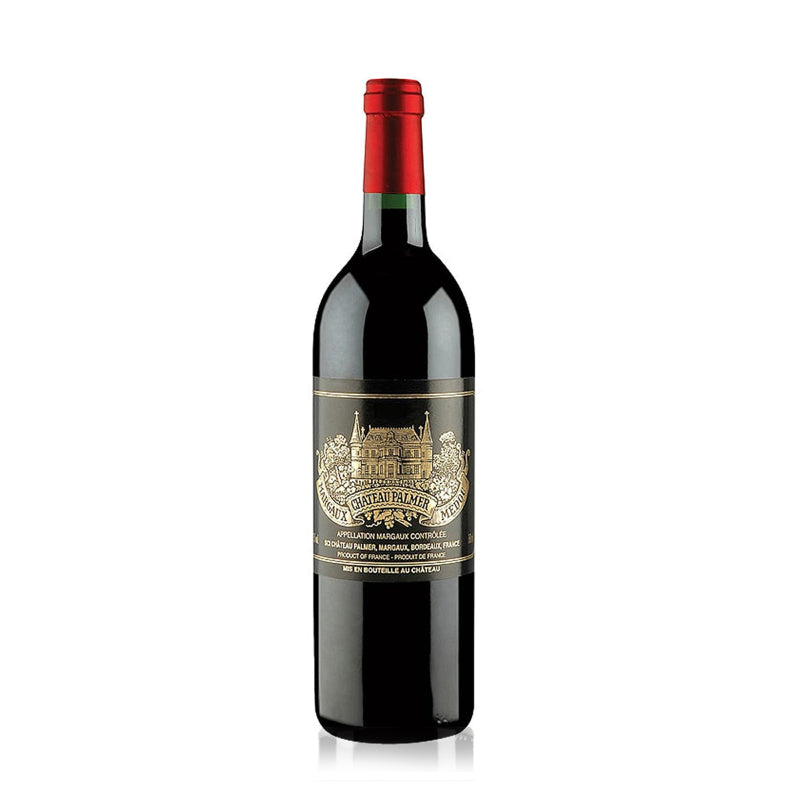
Chateau Palmer Margaux 2004 750ml


The 2004 Château Palmer, with a blend of 47% Merlot, 46% Cabernet Sauvignon, and 7% Petit Verdot, is a perfect balance of power and elegance. It features aromas of blackberries, truffles, flowers, and incense. Rated 94 by The Wine Advocate, it's medium to full-bodied with rich texture and great aging potential until 2025. Decanter also praised its elegance, silky tannins, and balanced acidity, making it an excellent wine for long-term aging.
The Wine Advocate | RP 94
Published: Jun 29, 2007
Drink: 2011-2025
This stunning wine is one of the vintage’s great successes. Administrator Thomas Duroux has fashioned a modern day version of Palmer’s brilliant 1966. Displaying a rare combination of power and elegance, this dense purple-colored offering exhibits notes of blackberries, truffles, flowers, incense, and camphor. Long, classic, and medium to full-bodied with stunning texture and richness, this superb effort is a candidate for the finest Margaux of the vintage. Anticipated maturity: 2011-2025+.
Decanter | D 92
Published: Mar 22, 2024
Drink: 2024-2045
I appreciated this supple, elegant wine with its approachable blackberry and blackcurrant fruit aromas touched with hints of fresh flowers, saddle leather, and spice. The texture seemed slightly restrained, with silky tannins and balanced acidity, but the finesse stood out. It was perhaps too understated to make a powerful impression on some of the tasters, but I felt it showed well and would continue to age with grace.
Jancis Robinson | JR 16.5
Published: Mar 5, 2014
Drink: 2013-2020
Luminous crimson. Sweet and slightly curranty on the nose. Lots of fresh fruit. Then crunchy tannins. In a riper vintage this formula might be unpleasantly OTT but this works.
Chateau-palmer.com
Château Palmer has always transcended fashions and trends to instead tap into a single voice: its terroir. The finesse and elegance of its Margaux roots, the softness and sophistication of its texture, the nobility of leather and the gentle caress of velvet. An almost identical blend of Cabernet Sauvignon and Merlot, rounded off with a touch of Petit Verdot, forge the Palmer style. The aromas offer an immersion in a bouquet of flowers, fruit, and spices, enveloped in a fleshy, generous structure.
Clement weather for a straightforward vintage, perfectly in keeping with the Palmer style. A classic, of course, yet one underpinned by the utmost precision thanks to meticulous vinification to bring out the full finesse and power of the harvested grapes.
In contrast to the two previous vintages, 2004 was defined by a suitable, mild climate. Nothing disrupted the vine cycle, and summer began after a month of very little rain in June. After an even flowering phase, without coulure, the mild summer temperatures helped to slow down and lengthen the ripening phase. September was dry and sunny, allowing us to wait calmly for each plot to offer up its best.
The grapes were gently vinified for an average of 21 days. In some cases, extraction was carried out at the beginning of the vatting process to express the grape’s flesh, while in others it took place throughout the maceration to give the wine more power.
The 2004 wines may seem very classic compared to those of 2003, but they magnificently combine the pedigree and finesse of our terroir with the body and strength of an excellent vintage. These wines are a fitting reflection of the Palmer vineyard’s generosity.
Technical Specs
Alcohol: 13.0%
Closure: Natural Cork
Vintage: 2004
Oak: French oak barrels; 60% new oak
Varietals: 47% Merlot, 46% Cabernet Sauvignon, 7% Petit Verdot
Vineyard: Château Palmer estate, Margaux; gravelly soils with clay subsoils
Harvest: 27 September–12 October 2004
Vinification: Gently vinified for an average of 21 days, with extraction tailored to each parcel to preserve fruit, finesse and structure
Ageing: Approximately 20 months in French oak barrels, with 60% new oak
Winemaker: Thomas Duroux
Region: Margaux, Bordeaux, France
Classification: 3ème Grand Cru Classé (Third Growth), 1855 Classification
Serving Temperature: 16–18°C
Decanting: Stand upright before opening to settle sediment. Decant gently for approximately 30–60 minutes; avoid excessive aeration
Food Pairing: Roast beef, lamb, venison, duck, beef Wellington, braised meats, mushrooms, truffle dishes and mature hard cheeses