
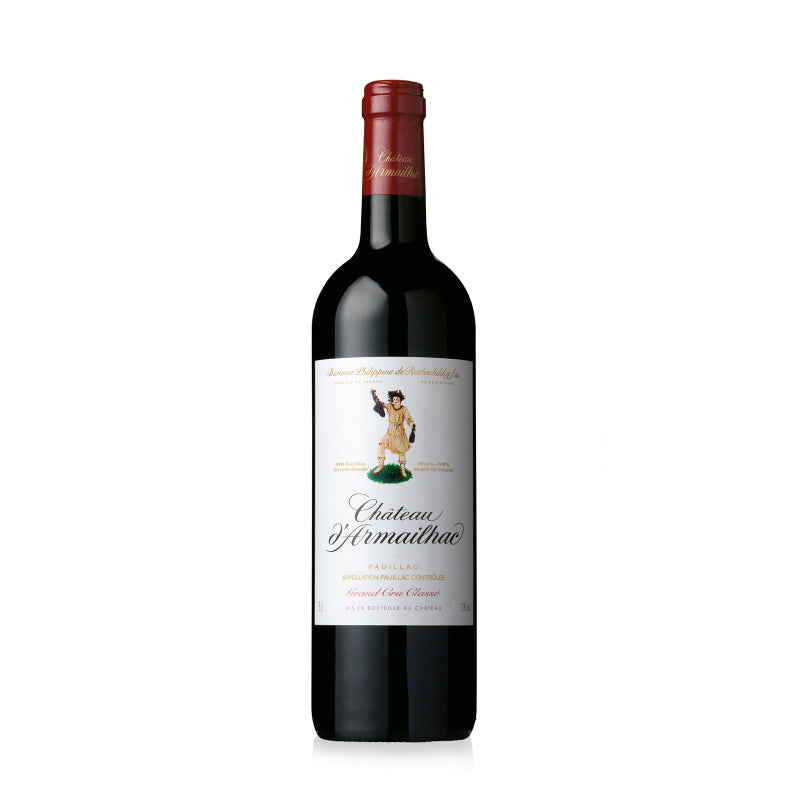
Chateau D'Armailhac Pauillac 2003 750ml


A mature and characterful Pauillac from a legendary hot vintage. The 2003 Château d’Armailhac shows classic cedar, tobacco and smoky notes layered with ripe red fruit and subtle spice. Medium- to full-bodied, it offers a firm yet silky structure, savoury depth and a long, sinewy finish. Rich without heaviness, this is a powerful but well-balanced Bordeaux now drinking beautifully, with the warmth of the vintage expressed through depth, generosity and classic Left Bank character.
The Wine Advocate | RP 92
Published: Mar 30, 2011
Tasted blind at Farr Vintner’s Left Bank tasting. A delightful, fresh, cedar-infused nose with fine definition: freshly rolled tobacco, just a touch of undergrowth, quite classic in style. The palate is medium-bodied, dry and austere on the entry, well defined with a tobacco dominated finish. This is sheer joy. Tasted October 2010.
James Suckling | JS 91
Published: Mar 14, 2011
Very fruity with strawberry and currants on the nose. Full bodied, with silky tannins and a long, fruity finish. Notes of toasted oak and spice develop on the palate, but this still needs some bottle age. Pull the cork after 2013. Find the wine
Decanter | D 91
Published: Nov 12, 2017
2003 was the year of the killer heatwave, and vines on shallow soils shrivelled under the onslaught, giving baked, raisiny wines. Pauillac has more clay, and thus moisture, so the vines suffered less stress. The nose is burly, hefty, and smoky, although still reserved. It's rich in the mouth, with dense tannins and heft rather than finesse. It lacks sucrosity and some freshness and flair, but it's not drying or flabby like so many 2003s. A powerful wine with a long, solid and sinewy finish.
Vivino | Vivino 4.1
A dense and deep red with a violet tint, the wine has a still slightly reserved nose which opens with airing on hints of cassis, blackberry and fresh red fruit mingled with touches of cedarwood. The attack is nicely rounded, with well-integrated tannins that fill out on a mid-palate full of fruit. The flavours linger pleasingly in a full and expressive finish that gives the wine a fine overall balance.
Chateau-darmailhac.com
Climatic conditions
Average rainfall in January and February was followed by exceptionally mild weather in March. Temperatures 2.5 C higher than normal for the season enabled the vines to bud over a period entirely within the average for the last thirty years, and five days earlier than the average for the Cabernet Sauvignon (29 March).
The drought that began in February continued from April to June, with 37% less rainfall than the average for the last forty years. The conditions continued to favour the vegetation cycle and the first flowers were seen at the end of May, seven days early.
The August heatwave will long remain in the memory, with temperatures rising to as high as 40? C on 4 August. There was also much less rain than normal. Mid-veraison was noted on 29 July, 9 to 13 days earlier than the average.
Hot and dry weather in September as a whole allowed the phenolic compounds to mature slowly and gradually. Although there were some showers in the early part of the month, the crop was harvested in excellent condition.
Harvest15 to 26 September
Varietal mix: Cabernet Sauvignon 65%, Merlot 20%, Cabernet Franc 12%, Petit Verdot 3%
Tasting notes
The wine has an attractive, forthright red colour and a refined, fruity nose on which cherry aromas mingle with violet and tobacco.
Round on the palate, with plenty of body and heft, it wraps its already silky tannins around a host of succulent flavours (red fruit, caramel, liquorice, menthol, roast coffee) to make a richly aromatic whole.
The finish bursts with fruit, rounding off a complete, refined and well-structured wine that is both vigorous and seductive, embodying all the allure of a very fine d?Armailhac.